Gustav von Aschenbach
Death in VeniceGustav von Aschenbach is a renowned writer whose life has been shaped by artistic discipline, public responsibility, and an exacting will. In the novella, that hard-won command becomes precarious: physical exhaustion draws him out of his ordinary routine, and his response to Tadzio carries him from controlled admiration into helpless desire, ending in his collapse and death in Venice.
Identity and Background
Aschenbach is introduced as a writer in his early fifties, officially styled von Aschenbach since his fiftieth birthday. A son of a senior legal official, he was born in L——, a leading city in Silesia. His ancestry joins two contrasting inheritances: generations of officers and government servants known for severe, steady service, and a more sensuous, fiery strain from his mother, the daughter of a Bohemian bandmaster. The narrative presents this union of conscientious discipline and darker impulses as the making of an artist.
His reputation rests on works that display both formal command and moral inquiry: a lucid prose epic about Frederick of Prussia, the fictional tapestry Maya, the stark tale The Wretch, and the treatise Art and the Spirit. The last brought together factual mastery and fluent presentation, qualities that led cautious judges to compare it with Schiller’s conclusions on naïve and sentimental poetry. These achievements establish him not merely as a successful author but as a writer whose public identity is bound to the authority of his work.
Discipline and Creative Life
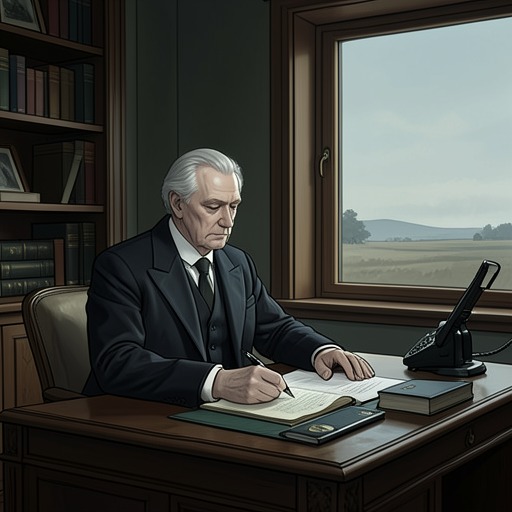
Aschenbach’s ambition to acquire a reputation shaped him from an early age. He made a name for himself almost as a schoolboy, and within ten years had learned to meet the world through his writing desk. Fame brought obligations as well as acclaim: his correspondence had to answer the many claims made on a successful and trusted person, while remaining brief, agreeable, and precise. By forty, he was already managing a daily mail bearing postmarks from countries around the world.
That public steadiness rests on sustained exertion. One spring afternoon, after a forenoon of precarious work demanding wariness, prudence, penetration, and rigor of will, he could not interrupt the momentum of composition even after lunch. He also could not obtain the restorative midday sleep increasingly required by his exhausted strength. Hoping that air and movement would prepare him for a productive evening, he went out for a long walk. The episode makes visible the cost of his discipline: work continues to propel him even when his body asks for rest.
Journey Toward Venice
The walk takes him through Munich’s English Gardens to the Aumeister, then across open fields toward the North Cemetery, where he waits for a tram as a storm threatens from the direction of Föhring. The outing belongs to a familiar world of routine and deliberate planning, but the cemetery and the gathering weather give that routine an uneasy edge. As the tram approaches along Ungererstrasse, he decides to devote the evening to maps and timetables. He also looks for the straw-hatted man who had accompanied his earlier wait at the station, but cannot find him at the platform, elsewhere nearby, or aboard the tram.
His later course in Venice places the same disciplined writer in a setting where observation no longer guarantees command. During his fourth week on the Lido, he notices that the hotel’s guests are dwindling and that German voices have largely disappeared from the dining room and beach. A barber’s casual remark that he has no fear of the plague alerts him to the outbreak. The episode connects Aschenbach’s private fixation with a wider atmosphere of concealment and danger: he remains at the Lido even as the city’s circumstances and the dwindling company around him signal that staying carries a cost.
Tadzio and the Surrender of Self-Command
Aschenbach’s attraction to Tadzio culminates in a smile that he receives as an intimate and almost fatal gift. The boy’s smile recalls Narcissus bending over the water, reaching toward the beautiful image that he cannot possess. Its force lies in its ambiguity: it appears at once coquettish, inquisitive, and troubled, while Aschenbach experiences it as both alluring and impossible to answer with composure.
He flees the light of the terrace and front garden for the darkness of the park, overwhelmed by what has passed between their glances. In a brief outburst, he admonishes the boy for smiling at another in that way, then sinks onto a bench, breathing in the night air and shivering. His whispered confession, “I love you!”, names the desire that his professional discipline cannot contain. The contrast is decisive: the writer accustomed to governing his expression and obligations is now undone by a smile he cannot explain away or turn into art.
Collapse and Narrative Significance
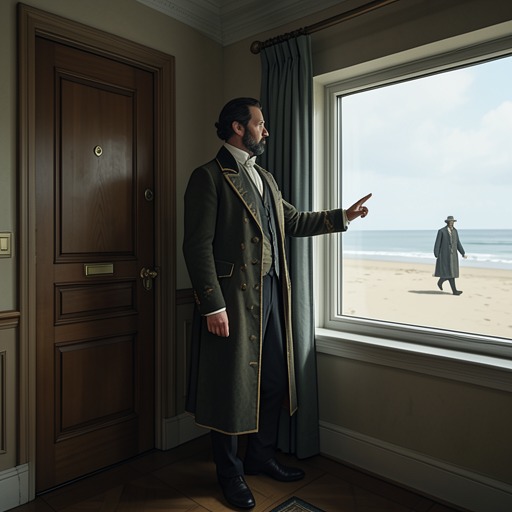
At the story’s end, Aschenbach remains a watcher on the shore as Tadzio walks across the shallows to a sandbank, separated from the mainland and his companions. The boy looks back over his shoulder and seems to Aschenbach to smile, nod, and beckon. The narrative presents that invitation as Aschenbach’s perception rather than an established communication from Tadzio; nevertheless, he rises once more to follow it. The gesture repeats the pattern of desire overriding judgment, now in a final scene of isolation and physical decline.
Minutes pass before anyone hurries to help Aschenbach, collapsed in a corner of his chair. He is carried to his room, and on the same day the news of his death reaches a respectfully shocked world. His ending reverses the public image built through years of work and self-command: the celebrated author dies not at his writing desk but after surrendering himself to the pursuit of an unattainable beauty. The novella’s tragedy depends on that tension between artistic discipline and the desire that breaks through it, while the plague and the dwindling hotel population place his private downfall within a threatened city.